Thursday, June 6, 2013

EyeO Festival, Day 0

    I'm not even going to try and quote Zach Lieberman's excellent keynote, it'll be up on Vimeo anyway.  I can't do it justice, but he really did say some things that lit a fire under me, especially when he called out people who spend their time building corporate demos for tradeshows and posited that CEOs shouldn't be the ones onstage telling the world what the future's going to be.  It's true, and I urge everyone, especially any of my colleagues in Perceptual Computing to keep an eye on Vimeo for when it's released (or just my facebook, since I'll be posting and reposting it probably a few times an hour).

    Watching the Ignite talks at EyeO tonight, I realized a few things:
  • I'm total weak-sauce for not submitting an Ignite talk, since I wouldn't have been the only first time speaker.
  • I haven't really given a talk on anything I REALLY care about since I spoke at Ringling.
  • If I want to do an Ignite talk next year, I need to start prepping now.  Holy jeebus those speakers were GOOD.
In fact, the last sorta public speech I gave, I was doing the exact opposite of that, i.e. I was being made to champion a cause I absolutely didn't believe in and tell a story that...wasn't really a story.  Seeing all those folks just KILL IT during the Ignite presentations really reminded me of what I love about public speaking, and that's telling stories I care about that give me an opportunity to connect with my listeners and inspire them.  I need the opportunity to do that again because, "Without Change, Something Sleeps Inside Us and Seldom Wakens."


I feel like I've been sleepwalking for the last month at least

    But enough positing!  There was actual content today, so let's talk about interesting things instead of listening to me spew opinion.  The first of two workshops today was a great intro to D3 from Scott Murray.  I'd been looking at d3 earlier this year and getting to play around with it reminded me of why I liked d3 in the first place and why I wouldn't mind doing a bit more javascript work.  I don't know if it's proper to say I want to do more javascript work, I think it's more that there are certain libraries that let me do certain things that just happen to be javascript, so really what I want to do is more work with said libraries and if that means a particular language, I guess that's it.  I mean, if it were about a particular language/toolkit's available libraries, by that logic I'd be much more of an ofx fan than a Cinder fan, yeah?  I'm really excited about the idea of using d3 and Three together, hadn't really thought much about that but the idea popped up today.  Could be fun.


It's kinda nuts how easy it is to make these in d3, even with animation and interactivity

    The second workshop was an applied math tutorial from the man himself, Memo Akten.  This course just reinforced to me how we really need to rethink the way we teach math in this country.  It also confirmed my suspicion that Memo is a machine.  Seriously, the way he talks about numbers and math, you can just tell he processes all that stuff differently than normal humans do, like...he SEES in linear algebra and trig.  I'm totally jealous, hopefully it'll come with practice.  The two things that I feel made this class work were a) the fact that the information was presented in such a way that concepts either built on top of each other or were otherwise shown in relation to each other and b) PRACTICAL EXAMPLES!  Honestly, I've always been comfortable-ish with Trig, but seeing some practical examples, like projector-to-camera mapping, for example, really just locked it in.  I put some notes online, they're probably only useful to me, but you're welcome to take a peek anyway: EyeO 2013 Applied Math Notes


...they're useful and make sense!

    Day 0 wrapped up with Zach Lieberman's amazing keynote and an incredible round of Ignite talks.  I really can't do them justice, so keep checking Vimeo for them, they're all worth watching.  Onto Day 1 for talks and hack-a-thons!

Tuesday, June 4, 2013

Eye-O Festival, Day -1

    I came to a really interesting realization this morning over some incredibly hot coffee (plus, Dunn Bros coffee on 15th? Yes, just, yes) that this may be the first time I've gone to a conference where I'm actually NOT interested in networking.  I mean, don't get me wrong, it'd be great to get my name out into the space a little, but I'd rather do it through real work.  Putting a few samples on github doesn't really count as compelling work, no matter how extensive the development might be (for the record, it's not much at this point).

    In all honesty, my interest lies in mapping the space, and again, not for a networking standpoint, I'm very interested just to see who's doing what in general, mainly because I think all this stuff is really cool (oddly enough, what brought me to intel).  I think if I had meant to network really hard, I would've tried a bit harder to make sure I brought business cards, so maybe my brain just knows things that I don't.  Yeah so, really excited to get a look at what people are working on, and just spend a few days writing code.  Workshops start tomorrow, first up D3 with Scott Murray, followed by Applied Math with the man himself, Memo Akten.  Mind preparing to be...expanded at least, probably blown.


My God, It's Full Of Code...

    So, here's a subject I don't talk about a whole lot, but it's definitely something I think about, for one reason or other.  This particular thought thread stems from my reading of this article: Intel Capital creates hundred million dollar Perceptual Computing fund.  Now, aside from this reinforcing my belief that it's time for me to go independent, a few things caught my eye.  First, there was the opening statement:

"That’s a lot of money, tech-art fans."

Second, the term "Tech Art" appeared in the Categories list for this article.  So of course I had to click on it and see what other articles fell under that category.  Quite an interesting list, one of them being an article highlighting the release of processing 2.  Being here at Eye-O festival, now somewhat surrounded by people who make art by writing code, really makes me ponder that term "Tech Art" and what a "Tech Artist" really is.  I'm probably not very qualified to speak on what the future of "Tech Art" as a game development discipline is, but ultimately, I'm not really sure there's such a thing as a Tech Artist in games anymore.  Well that's not true, but I definitely think they're becoming fewer and further between.


When code meets art (or at least my feeble attempt)...

    You see, somewhere back up the line, Tech Artists became much more specialized, almost to the point where I'm not sure the title "Tech Artist" was really applicable anymore.  All of a sudden we had riggers, technical animators, dcc tools developers, shader programmers, even physics artist, but to me, a proper Tech Artist was all of these things.  I wrote my first auto-rigging tool in 2002, and I wrote my first Cg (proper Cg, not CgFX) shader not much later, and you know, back then that was the job.  When that "normal mapping" thing started to be whispered in games circles (a lot longer ago than most of you kids think), I was one of the first people to write a normal map extractor from Maya and a Mental Ray shader to test it.  Yep.  And again, that was just the job?  A Tech Artist was rigger, dcc tools programmer, shader writer, fx artist, jack of many different languages, and sometimes even modeler and renderer.  I feel like nowadays, that original diversity and spirit of exploration that defined tech art once is gone, and now the extent of it is finding new ways to solve the same old problem inside whatever tech art sandbox you've chosen.  Sheesh...borrow someone else's solution and use all that free time to learn something NEW, trust me, your pipeline isn't that complex, and your toolchain requirements aren't that special.  Your production process is not a unique delicate flower, for shame.

    I can't really say if the current trend of specialization is going to continue, I imagine it will and people will make the argument that the increasing complexity of AAA game content will require it, but you know, I went from PS2 and low spec PC all the way to the dusk of the 360 and PS3, and I think I chose to work faster and smarter, rather then continue to add complexity to my chosen sandbox (or job security, whichever you want to call it).  I think it's that approach to Tech Art that continues to serve me well in the world of RED, and just to get a little sentimental, it warms my heart to see that original spirit of Tech Art continuing to live on as Creative Coding.


    Andrew Bell said it best at Eye-O last year, TDs (and of course, TAs) are Creative Coders for games and film.  I think this was much more true back in the day (FUCK ME I'M OLD), and I'd like to see Tech Artist return to that original spirit of exploration and diversity, rather than continuing to play "how many ways can i make up to solve the same maya problems everyone else has already solved?".  That said, tomorrow is Eye-O!  Time to shut my mouth, open my eyes, and engage my brain.  This should be awesome.

Monday, June 3, 2013

Eye-O Festival, Day -2

    I think I've aged about 20 years in the last month or so because I feel like I've just gotten super preachy, which is somewhat annoying, though probably less to me and more to the people to whom I've been preaching.  I don't know, I feel like all these thoughts, observations, and opinions have sorta been brewing over the last while and I've decided I need to start recording more of my internal monologues, not that they're any good, but it gives me some talking points if in the future I ever end up talking to anyone who's listening.  So that said, you can probably guess this isn't going to be a very technical post, but hey, I'm at Eye-O!  Trust me, there will be tons of technical musings coming...Plus, I'm going to use a lot of marketing/businessey terms, for which I am also truly sorry...don't hate me, my friends (or do, i suppose).


We deliver all three, yo...

    You get to that point sometimes where you've had a bunch of related conversations with different people and it all adds up to one conversation, or at least, it would be more efficient and probably effective to just have the whole conversation rather than have bits and pieces with different people.  It's definitely been that kind of week/month/year/etc.  I've been thinking, talking, trying to practice, etc what being a rapid experience developer, interaction prototyper, interactivist, whatever you want to call it, etc, and I don't think I've quite succeeded yet.  Most of that is probably due to the fact that I've spent more time being an evangelist, educator, excel jockey, etc, otherwise not really an experience developer.  That said, the one really useful skill I took from my time in the games industry was learning to observe and analyze process, learning what was and wasn't important, and I gotta say I got pretty good at it.  So that said, here are my own thoughts on being a Rapid Experience Developer...(I'm probably 100% wrong).

    I think a big part of this thought thread started quite a while ago (well, as the internet goes anyway) when a friend of mine was pitching a hardware device to me and I kept interrupting and asking what the experience was.  When developing experiences, especially for mainstream consumption, it all starts with the approach.  I've noticed that here in tech-land it's all too easy for us to fall back to things like features and implementation details, or presentation and visual details, you know, the things we're good at, but let's be honest, only the pundits, marketers, and people who need techno-babble to sound intelligent care about individual features, and of those people, an even smaller slice care about anything lower level than that, algorithms and optimization details, for instance.  Now don't get me wrong, I'm a developer/geek (seriously, don't let the powerlifting and MMA fool you, that's just my security blanket) at heart, I can go on about that stuff all day and then a few more, but in the right company at the right time.  So mastering the art of the pitch?  Crucial to rapid experience developers (henceforth, RED).


Everything in its place...

    First off, there's the overall mindset that comes with delivering a successful pitch.  When we realize that we only have a very set amount of time to make people "get it", we really start to focus in on what our overall messaging has to be, so it goes with RED.  Our experience has to communicate its essence to either an uninformed user, or even worse, a user who thinks they're informed, both of which are uphill battles.  Nowadays, most people have...what I'll call a latent knowledge of experiences, that is, we're so inundated with interactive technology that we know what we DON'T like.  If you've ever been in a production job, you know how annoying it is to work with creative leads who pull that stuff (oh, I'll know it when I see it), and while it's acceptable to not put up with that garbage in that situation (I mean really, that's just unprofessional), we can't really hold our target audience to that same standard, so the onus is really on us to...not really know what they want end-to-end, but at least put something in front of them that gets them in.  We don't need to sell someone a product, but we do need to make sure it stays with them (no easy feat given today's short attention spans.  I blame internet.)

    Another crucial element of the pitch process is that it puts us into the role of storytellers, and as any good storyteller knows, we have to be able to connect with our audience.  A big part of that is being able to put ourselves into the mindset of said audience.  You know, in that way, RED is a lot like being an artist, in that the best artists are those who can see through their audience's eyes and know what they'll be looking for/at.  Ok, I know that's a little hippy/new-agey, but I think it's a valid idea, and ultimately, I think it's the closest we're going to get to getting any sort of an indicator as to what our audiences are going to want from our experience (see, again, the onus is on US).  Additionally, telling the experience as a story is a great tool for how to structure the experience overall.  What's the introduction, i.e. what's that hook that's going to get the user engaged initially?  Next, what's the "meat" of the experience, that is, the body of the story?  What is it that's going to keep the user around for a bit?  Lastly, how do we resolve the experience and give the user some impetus to at the very least stay tuned to see what's in store for either the next iteration or the next story we choose to tell?  That's quite a bit to think about, and when we consider we may only have a few weeks to put all this together, well...are we starting to think a little differently about how we approach development?

    The last thing I'll touch on here about the pitch process is that it teaches us really quickly that we CANNOT fall in love with our pitch, our product, and most especially, our process.  The same goes for an experience, especially when it comes to RED.  Now, I realize that strikes a bit counter to what I'd previously said about RED being like art, but make no mistake, while we borrow tenets and process from art, we are NOT making art.  At best, we're creating a beautiful corpse, and at worse, we're creating a trinket or a bauble to fill some space.  Hopefully not too much of the latter, but it will happen, and when that order comes down, crap it out, flush it down the pipe, and get back to what matters.  When we start developing an experience, we've got all these great ideas about all the features we want to include, an all the cool things we're going to write into it, and all the great infrastructure we're going to build, but you know what?  The minute that stuff starts throwing up walls, trash it and move through.  Coding style?  Screw it.  Properly modeled and textured meshes?  Save that noise for polycount.  Here's the question we should be asking ourselves at every step: If this experience were being demoed for 60 seconds (which is probably longer than it will be demoed in actuality), would it totally suffer if I didn't implement this feature that's had me stuck implementing for the last week?  If I were to just fake it, would anyone care?  Answer is probably not, unless it's some sort of interaction model we're trying to work through.  Now, I know at this point someone wants to make the argument that "Presentation Counts!  Visuals Matter!".  That may be true, but I wonder what a little company called Rovio thinks about that, and the same goes for technical details.  You probably get my point, but if you don't let me summarize by paraphrasing Einstein, "visuals, presentation, and code should be as aesthetically pleasing and functional as they need to be, but no more."  Focus on what matters, forget what doesn't, and who cares if you're embarrassed to show someone your code or source files at the end?  Chances are, no one's even going to ask, so...check it in and call it good.


Seriously, just put it in a private repo, i don't wanna know, it's cool

    I think i'll leave this with one of my favorite creative coding projects, Red Paper Heart's Golden Clock.  I like this for so many reasons (Cinder represent!!), but the main reason I like it is because it was developed by four people in 10 days.  And this wasn't a prototype, mind you, this was a mission critical application, in front of hundreds of people, with different degrees of interactivity that had to run the duration of a party with it being the backdrop for the evening's main event!  If this can be done in ten days by four people (albeit four kick ass developers and artists), imagine what one really capable RED could do in a month...There's your brass ring.

A Golden Clock from Red Paper Heart on Vimeo.

Sunday, March 31, 2013

[TUTORIAL] Visualizing Depth in Unity, part 2

    The joys of having a laptop capable of development, I'm seriously in love with my Ultrabook.  This isn't just me shilling for the company, I'm totally sold on this thing.  Apple did right by forcing people to figure out how to build smaller, lighter laptops that still pack serious development punch.  For reference, I'm currently working off of a Gigabyte U2442, would be nice to get something that has a Core i7 CPU, but this one's a Core i5 at 3.1 with a mobile Geforce 6xx, so I'm happy with it.  Made it easy for me to bang out this second depth sample from the comfort of a...actually I think it was a bar as opposed to a coffee shop...


The Technolust, i sorta haz it...

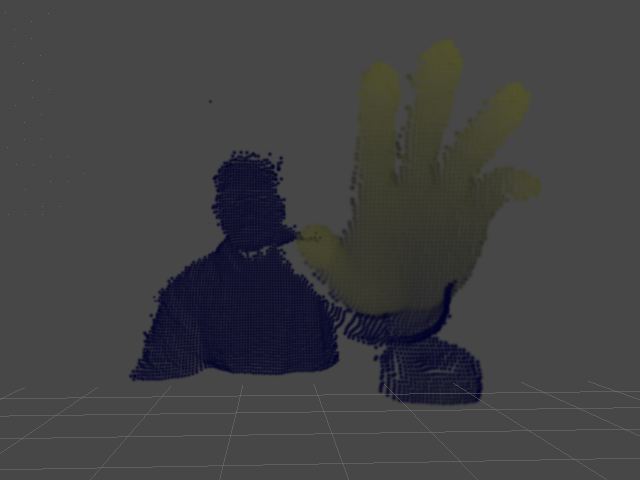
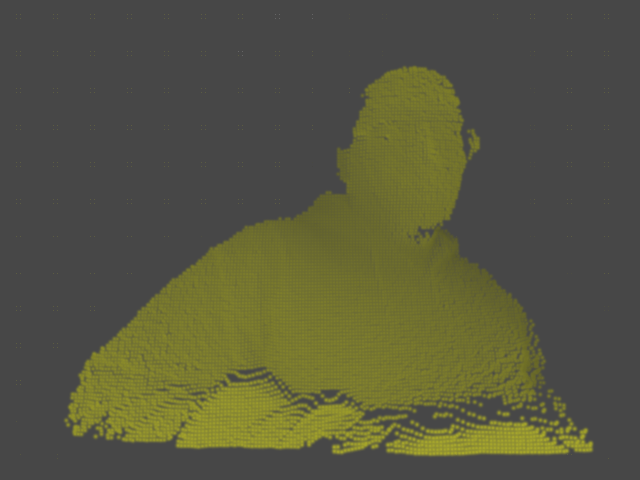
    I mentioned in my last post I'd been messing around with some other methods for visualizing depth from the Creative Camera, I took a few moments after GDC to decompress and finish this one up, it sorta builds off the last sample.  Instead of visualizing a texture, I'm using the depth to set attributes on some particles to get that point cloudy effect that everyone seems to know and love.  This one's a bit more complex, mainly because I added a few parameters to tweak the visualization, but if you've got some Unity under your belt, none of this will be that tricky, and in fact, you'll probably see pretty quickly how setting particle data is very similar to setting pixel data.  I should also note that the technique presented here could apply to any sort of 3d camera, pretty much if you can get an array of depth values from your input device, you can make this work.  So here's what we're trying to accomplish when all's said and coded:


    Since this is a Unity project, we'll need to set up a scene first.  All that's required for this is a particle system, which you can create from the GameObject menu (GameObject > Create Other > Particle System).  Set the particle system's transforms (translate and rotate) to 0,0,0 and uncheck all the options except for Renderer.  Next, set the Main Camera's transform to 160,120,-240, and our scene is ready to go.  That all in place, we can get to coding.  We'll only need a single behavior for this test, which we'll put on the particle system.  I called mine PDepth, but you'll call it Delicious (or whatever else suits your fancy)!  First, let's set up our particle grid and visualization controls:

//We'll use these to control our particle system
public float MaxPointSize;
public int XRes, YRes;

private ParticleSystem.Particle[] points;
private int mXStep, mYStep;

  • MaxPointSize: This controls the size of our particles
  • XRes, YRes: These control the number of particles in our grid
  • points: This container holds our individual particle objects
  • mXStep, mYStep: These control the spacing between particles (this is calculated, not set manually)

    With those in place, we can populate our particle grid and get some stuff on screen.  Here's what our initial Start() and Update() methods should look like:

void Start()
{
    points = new ParticleSystem.Particle[XRes*YRes];
    mXStep = 320/XRes;
    mYStep = 240/YRes;

    int pid=0;
    for(int y=0;y<240;y+=mYStep)
    {
        for(int x=0;x<320;x+=mXStep)
        {
            points[pid].position = new Vector3(x,y,0);
            points[pid].color = Color.white;
            points[pid].size = MaxPointSize;
            ++pid;
        }
    }
}

void Update()
{
    particleSystem.SetParticles(points, points.Length);
}

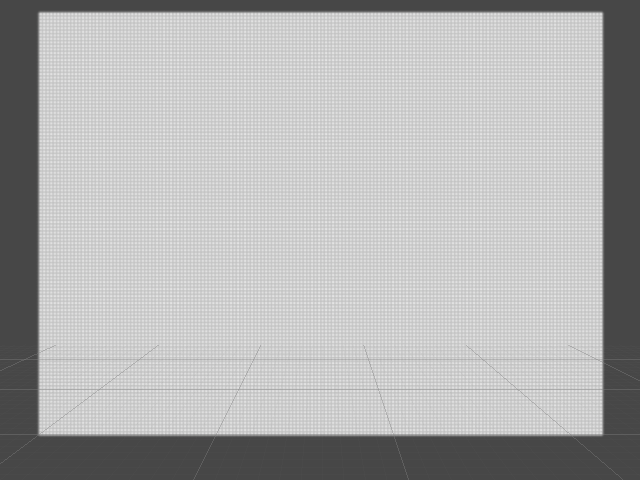
    If you're wondering where the values 320 and 240 came from, we're making some assumptions about the size of our depth map to set the initial bounds.  Once we add in the actual depth query, we'll fix that and not have to rely on hardcodes.  Otherwise, if all went according to plan, we should have a pretty grid of white particles.  Be sure to set some values for XRes, YRes, and MaxPointSize in the Inspector!  For this example, I've used the following settings:
  • XRes: 160
  • YRes: 120
  • MaxPointSize: 5

    As I mentioned earlier, this procedure actually isn't too much different from the previous sample, in that we're building a block of data from the depth map then loading it into a container object, just in this case we're using an array of ParticleSystem.Particle objects instead of a Color array, and we're calling SetParticles() instead of SetPixels().  That in mind, you've probably already started figuring out how to integrate the code and concepts from the previous tutorial into this project, so let's go ahead and plow forward.  First, well need to add a few more members to our behaviour:

public float MaxPointSize;
public int XRes, YRes;
public float MaxSceneDepth, MaxWorldDepth;

private PXCUPipeline mSession;
private short[] mDepthBuffer;
private int[] mDepthSize;
private ParticleSystem.Particle[] points;
private int mXStep, mYStep;

  • MaxSceneDepth: The maximum Z-amount for particle positions
  • MaxWorldDepth: The maximum distance from the camera to search for depth points
  • mDepthBuffer: Intermediate container for depth values from the camera
  • mDepthSize: Depth map dimensions queried from the camera. We'll replace our hardcoded 320,240 with this

    The only major additions we need to make to our Start() method involve spinning up the camera and using some of that information to properly set up our particle system.  Our new Start() looks like this:

void Start()
{
    mDepthSize = new int[2];
    mSession = new PXCUPipeline();
    mSession.Init(PXCUPipeline.Mode.DEPTH_QVGA);
    mSession.QueryDepthMapSize(mDepthSize);
    mDepthBuffer = new short[mDepthSize[0]*mDepthSize[1]];

    points = new ParticleSystem.Particle[XRes*YRes];
    mXStep = mDepthSize[0]/XRes;
    mYStep = mDepthSize[1]/YRes;

    int pid=0;
    for(int y=0;y<mDepthSize[1];y+=mYStep)
    {
        for(int x=0;x<mDepthSize[0];x+=mXStep)
        {
            points[pid].position = new Vector3(x,y,0);
            points[pid].color = Color.white;
            points[pid].size = MaxPointSize;
            ++pid;
        }
    }
}

    The bulk of the changes are going to be in the Update() method.  The big difference between working with a particle cloud and a texture as in the previous example is that we need to know the x and y positions for each particle, thus the nested loops as opposed to a single loop for pixel data.  This makes the code a bit more verbose, but not a ton more difficult to grok, so let's take a stab at building a new Update() method:

void Update()
{
    if(mSession.AcquireFrame(false))
    {
        mSession.QueryDepthMap(mDepthBuffer);
        int pid=0;
        for(int dy=0;dy<mDepthSize[1];dy+=mYStep)
        {
            for(int dx=0;dx<mDepthSize[0];dx+=mXStep)
            {
                int didx = dy*mDepthSize[0]+dx;

                if((int)mDepthBuffer[didx]>=32000)
                {
                    points[pid].position = new Vector3(dx,mDepthSize[1]-dy,0);
                    points[pid].size = 0.1f;
                }
                else
                {
                    points[pid].position = new Vector3(dx, mDepthSize[1]-dy, lmap((float)mDepthBuffer[didx],0,MaxWorldDepth,0,MaxSceneDepth));
                    float cv = 1.0f-lmap((float)mDepthBuffer[didx],0,MaxWorldDepth,0.15f,1.0f);
                    points[pid].color = new Color(cv, cv, 0.15f);
                    points[pid].size = MaxPointSize;
                }
                ++pid;
            }
        }
        mSession.ReleaseFrame();
    }

    particleSystem.SetParticles(points, points.Length);
}

    So like I said, a bit more verbose, but hopefully not terribly difficult to understand.  A few things to be aware of:

int didx = dy*mDepthSize[0]+dx;

    We use the variable didx as an index into the depth buffer.  The reason we do this is because our particles don't correspond 1:1 to values in the depth buffer, so we use each particle's x and y position to do the depth buffer lookup.  In the next example, we'll take a look at how we can actually have a 1:1 depth buffer to particle setup using generic types.

if((int)mDepthBuffer[didx]>=32000)
{
...
}
else
{
...
}

    Here, the reason we test against a depth value of 32000 is because this is what the Perceptual Computing SDK uses as the error term.  So if the SDK can't resolve a depth value for a given pixel, it sends back 32000 or more.  In this case, if we find an error term, we make the particle really small, but in the next example, we'll look at how we can skip that particle altogether if we have an error value.  Finally, remember we need to implement some sort of range remapping function, I call mine lmap as a homage to Cinder's remap, but you can call it whatever, again, it's basically just:

float lmap(float v, float mn0, float mx0, float mn1, float mx1)
{
    return mn1+(v-mn0)*(mx1-mn1)/(mx0-mn0);
}

    So that's that, in the next sample, we'll look at some different ways to map the depth buffer to a particle cloud and use the PerC SDK's UV mapping feature to add some color from the RGB stream to the particles.  Until then, email me, follow me on Twitter, find me on facebook, or otherwise feel free to stalk me socially however you prefer.  Cheers!


What can i say, i love OpenNI...

Wednesday, March 27, 2013

[TUTORIAL] Depth maps and Ultrabooks

    Went to a really great hack-a-thon this past weekend at the Sacramento Hacker Lab to help coach some folks through working with the Perceptual Computing SDK and got to see some really cool work being done, everything from a next-generation theremin to a telepresence bot, all powered by the Creative 3D Camera and Perceptual Computing SDK.  Does me good to actually get out into the community and see people just dive right in and start building stuff.  Compound that with the GDC Dev Day that personally I think went amazingly well (standing room only at one point!) and it's been a good GDC for Perceptual Computing so far.  But now comes the really hard part, which is that PerC needs to not become a victim of its own success.  As the technology gets into more hands, now it becomes about not burning through goodwill by breaking features, being uncommunicative, or not keeping up with the ecosystem.  But I digress...

    Wanted to share a little Unity tip I got asked about a few times during the hack-a-thon, and that's how to visualize the depth map.  The SDK ships with a sample for visualizing the label map, and visualizing the color map is a fairly trivial change, but visualizing the depth map requires a little bit of doing.  It's actually pretty trivial from a working standpoint, so let's take a look at what's required.

    To get a depth map into a usable Texture2D, the basic flow is:
  • Grab the depth buffer into a short array
  • Walk the array of depth values and and remap them into 0-1 range
  • Store the remapped value in a Color array
  • Load the Color array into a Texture2D
    If that seems really simple, fear not, it actually is, so let's take a look at some code and see how we accomplish this.  Here's a really simple Unity behavior that populates the texture object from the depth map.  I'll leave assigning the texture as an exercise to the readers:

using UnityEngine;
using System.Collections;

public class Test : MonoBehaviour
{
    private PXCUPipeline mSession;
    private int[] mDepthSize;
    private short[] mDepthBuffer;
    private int mSize;

    private Texture2D mDepthMap;
    private Color[] mDepthPixels;

    void Start()
    {
        mDepthSize = new int[2];
        mSession = new PXCUPipeline();
        mSession.Init(PXCUPipeline.Mode.DEPTH_QVGA);
        mSession.QueryDepthMapSize(mDepthSize);
        mSize = mDepthSize[0]*mDepthSize[1];

        mDepthMap = new Texture2D(mDepthSize[0], mDepthSize[1], TextureFormat.ARGB32, false);
        mDepthBuffer = new short[mSize];
        mDepthPixels = new Color[mSize];
        for(int i=0;i<mSize;++i)
        {
            mDepthPixels[i] = Color.black;
        }
    }

    void Update()
    {
        if(mSession.AcquireFrame(false))
        {
            mSession.QueryDepthMap(mDepthBuffer);
            for(int i=0;i<mSize;++i)
            {
                float v = 1.0f-lmap((float)mDepthBuffer[i],0,1800.f,0,1.f);
                mDepthPixels[i] = new Color(v,v,v);
                mDepthMap.SetPixels(mDepthPixels);
                mDepthMap.Apply();
            }
            mSession.ReleaseFrame();
        }
    }

    float lmap(float val, float min0, float max0, float min1, float max1)
    {
        return min1 + (val-min0)*(max1-min1)/(max0-min0);
    }
}

    So like i said, fairly simple, albeit verbose technique, but should be fairly easy to wrap it up into a simple function for quick future use.  This same technique can also be used to visualize the IR map with some very minor tweaks.  I've actually been doing alot of stupid depth map tricks the last few days.  I'm at GDC all this week so I'm not sure how much dev time I'll get to be able to polish a few more of these up but maybe the weekend'll afford me some cycles if i'm not in full on crash out recovery mode...

Friday, March 1, 2013

Milestone presents!

    5000 pageviews for me just ranting is pretty cool, so have some surprise processing code!  I won't tell you what it does, basically it came out of a Unity UI experiment Annie's been working on and my desire to learn how processing's PVector interface really works.  Found some interesting quirks, tho having more to do with 2d and 3d and PVector being a 3d construct vs PVector's implementation, i'm going to say (since Shiffman's a genius and probably knows what he's doing).  Anyway...have fun (and send Annie a hey if you end up using this code for something)!  If it's any hint, i call this "Spider Silk"...(poetic, no?)

float thresh = 0.5;
//world vectors
PVector v_ctr_w = new PVector(0,0);
PVector v_0_w = new PVector(0,0);
PVector v_1_w = new PVector(0,0);

//image vectors
PVector v_ctr_i = new PVector(0,0);
PVector v_0_i = new PVector(0,0);
PVector v_1_i = new PVector(0,0);

void setup()
{
  size(500,500,P2D);
  stroke(128);
}

void draw()
{
  background(0);
  v_ctr_i.set(map(v_ctr_w.x,-1,1,0,width),map(v_ctr_w.y,-1,1,0,height),0);
  v_0_i.set(mouseX,mouseY,0);
  v_0_w.set(map(v_0_i.x,0,width,-1,1),map(v_0_i.y,0,height,-1,1),0);
  
  line(v_ctr_i.x,v_ctr_i.y,v_0_i.x,v_0_i.y);
  ellipse(v_ctr_i.x,v_ctr_i.y,50,50);
  fill(0);
  ellipse(v_0_i.x,v_0_i.y,30,30);
  
  fill(255);
  if(v_0_w.mag()<thresh)
    v_1_w.set(v_0_w.x,v_0_w.y,0);
  else
    v_1_w = PVector.mult(v_0_w,thresh/v_0_w.mag());

  v_1_i.set(map(v_1_w.x,-1,1,0,width),map(v_1_w.y,-1,1,0,height),0);
  ellipse(v_1_i.x,v_1_i.y,15,15);  
}

void mousePressed()
{
  thresh = v_0_w.mag();
}

Sunday, February 24, 2013

A little time to breathe...

    First time in a while i've felt like i had a Sunday morning, not sure why that is, but it's nice to have a little room to do some random. Thought I'd just take a moment and touch on some of the things I've been working on, mainly to gloat about all the cool shit I'm doing.  No, no that's not true, honestly professional life has taken a tiny bit of a turn in that I'm pretty much heading fully down the management track now and am relegating myself to weekend code warrior.  This is all totally by choice, mind you, because if I've come to realize anything in the last year it's that i REALLY love software arting, like, in a bad, unnatural way.  No, that's also not true, at least the last part.  After 10+ years, I think i'm just burned out on industrial strength development for money in general, just because there are specific things I like doing with code, and I'm probably not going to get to do those things unless I start my own company (prospective employers and recruiters, take not).  I think I've also gotten to the point in my career where I feel like I've amassed enough knowledge and experience to be a pretty good teacher, which in a weird way has brought me back around to management.


Hear me out, seriously...

    To me, management done properly is very much about facilitating, mentoring, and sheltering the team, which, if you think about it, parallels teaching a bit (actually, when I think about it, it also parallels parenting a bit, maybe I'm just getting to that age where I'm wanting to have kids...no, no, that's a terrifying thought).  No, I've always liked the idea of teaching, for which I blame my family.  There are quite a few good teachers/educators, in fact, now that I think about it, EVERYONE on my mom's side of the family are teachers.  It's not so much the power and ego trip of having the authority or getting attention and letting the world know how smart i am, i just like it when knowledge is shared.  In my old age, i'm getting less and less ok with the idea of making money off of ideas.  Sure, you have to start with an idea, but nowadays especially, too many people get so far with the idea and don't take it through.  I put code on github on a fairly regular basis, code that some people consider potential ip, but man, it's just not.  It's just knowledge waiting to be re-applied.  Something we all need to keep in mind, methinks.

Coding For Creative Non-Coders
    So i've gotten a few questions about Coding For Creative Non-Coders (which is weird that people were actually even paying attention to that) and the short is, it's not dead (just dreaming).  I've had the opportunity to present the curriculum in a few different live venues, which means I'm focusing on cleaning it up and getting it presentable to a live audience.  Means it'll be a while before it's actually published here, but it also means that by the time it gets here there'll be a ton more content and it'll all flow together a bit more.  One of the issues that bothered me about the curriculum initially was that it didn't really go anywhere, it sorta stopped at putting random things on screen with processing.  The new, refocused curriculum deals with visualizing social networking data, so we'll go from not knowing much about coding at all to being able to scrape web services for data and displaying said data.  Cool eh?  So if you were watching, waiting, wondering, i apologize for taking it dark like that, but rest assured, it'll be worth it, methinks.  If you're in the bay area, keep watching the GAFFTA website for more details on the class, and feel free to pop in!

teaser

Cindering and Other Creative Coding
    Dunno if anyone found my Cinder rantings at all useful (probably not), but if you did, fear not, more of those are on the way as well.  I'm pretty much deep into development at this point, churning on content for GDC, workshops, and a new SDK release, which means when i'm not managering, i'm coding pretty fiercely, and haven't taken the time to stop and do proper writeups like i should.  Hopefully the code will be self-documenting enough, though I do plan on releasing some sort of documentation for certain projects (Cinder block, ofx addon, Unity samples, etc).  Basically, useful code is on the way, so fear not.  If all goes according to plan, everything should line up with the SDKs Gold Release, which is...well, soon.

Thinking, Thinking
    About pretty much everything.  As i type this, i have a window open with a linkedin message to a google recruiter in a somewhat unfinished state.  I don't really want to work for google, in fact, after Intel i really don't want to work for anyone but me anymore on smaller, project based contracts.  It was actually my initial contact with google that got me thinking about that because they didn't really have a job for me, it was more that they think they like my skillset, or at least what they can tell of it from paper.  So it's probably the case of they just want to bring on engineering resources, then assign them to projects, or even more, the oft-romanticized work on whatever project interests you, made popular by such groups as Valve (wonder how that worked for the crew they just laid off...).  I notice alot of people think that sort of environment is fairly attractive, but if i've learned anything about my work habits, it's that i REALLY like projects.


...always looking towards some horizon, i suppose...

    Ultimately, I'd rather be hired because someone saw my body of work and thougth that was attractive, rather than a few lines under the "Skills" heading on a website.  I'm actually considering removing specific languages from my LinkedIn profile and just adding frameworks, SDKs, APIs, environments, etc.  I imagine that would blow some recruiter's mind pretty hard, but the flipside is i would probably get approached by people who really wanted to work with me on things I was really interested in working on.  Might be an interesting experiment.

    Experiment...that's another incredibly relevant descriptor.  I think my whole time at Intel is going to be a series of experiments, from proving some ideas I have about project management to going from tech artist to UX Developer/Project Manager.  It's daunting but exciting at the same time, I think my limited experience managing Tech Artists is probably going to be a big help when it comes to managing the crew i'm working with right now.  I say i'd never go back to game development, but who knows?  If my ideas turn out to be correct, might be fun to do some indie development.  Dunno tho, i think any game i made wouldn't do too well because after Intel, i don't think i could adhere to the established input modalities that games seem to be comfortable with.  Ah well, UX Development Manager it is, I suppose.  For now.